LIMERICKS
LEVEL: INTERMEDIATE

| There was an Old Man with a nose, Who said, 'If you choose to suppose, That my nose is too long, You are certainly wrong!' That remarkable Man with a nose. |
This my dear friend is a LIMERICK. A limerick is a type of funny POEM. Poems and RHYME are great ways of building your vocabulary (see the glossary).
This week´s lesson will end with you writing your own limerick in English. Yes, you will be a POET in the language of POETRY!
ORIGINS:
Limericks appeared in England in the early 18th Century. No one knows where they came from, but they are named after a part of Ireland. Perhaps, the Irish were the first to write them. They were usually rude or bawdy. If you want to read some very rude limericks then google them, but here is one tasteless example in very small font.
There once was an old man from Sweden
Who walked through the garden of Eden
He took off his clothes
And showed off his toes
That salacious old man from Sweden
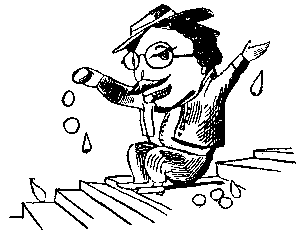
Limericks became a publishing phenomenon in the 19th Century with Edward Lear´s nonsense poetry. Unlike the earlier bawdy examples, Lear´s limericks are humorous without being shocking. Here´s another one of his.

There once was an old person of Chili,
Whose conduct was painful and silly,
He sate on the stairs,
Eating apples and pears,
That imprudent old person of Chili.
So far you might have noticed the first lines of a limerick are very easy to emulate... ´There was or once was a person, man woman from somewhere...´
EDWARD LEAR:
Edward Lear was born in 1812 in Middlesex, England. Strange as it might seem, though he was one of 21 brothers and sisters, yet he suffered loneliness all his life. Despite lifelong health problems he travelled the world and, as a great painter of birds, was employed by Queen Victoria to teach her to paint. She was an enthusiastic student if not a very capable one. This is one of Lear´s paintings:

It´s obviously a flamingo. Incredible use of colour, look at the detail in the eye and sense of movement. This, however, is one of Queen Victoria´s later paintings:

No one knows what it is. But it´s called My Dream.
Edward Lear was a man who wished to hop down the halls of palaces and amuse the very sensible company he kept.When Edward Lear died in 1888, not one of his friends attended his funeral. They were all busy. Sad as this was, his poems and his drawings attract new fans even now and have had, like Lewis Carroll´s Alice in Wonderland, a huge influence on shaping the English sense of humour. In fact, his limericks are as funny today as the comedy tv of his successors. You can check out his poems here: http://www.bencourtney.com/ebooks/lear/index1.html
 |
| Lear´s successor Vic Reeves with Bob Mortimer on Shooting Stars a nonsensical programme |
FORM:
Let´s look at the FORM of the limerick: ´There was an Old Man with a nose´ by Edward Lear.
How many LINES does it have? What are the words that RHYME? What is the RHYMING PATTERN? How many SYLLABLES does it have on each line? Which lines are the longest and which are the shortest?
 |
| Cyrano de Bergerac - a Nose. |
The limerick has 5 lines. The rhymes are : Nose with Suppose and Nose (again!), and Long with Wrong. So the rhyming pattern is AABBA.
| A - There was an Old Man with a NOSE, A - Who said, 'If you choose to SUPPOSE, B - That my nose is too LONG, B - You are certainly WRONG!' A - That remarkable Man with a NOSE. |
The B lines have 6 syllables and generally they always do too.
syllables A - Who-said,-´if -you-choose-to-sup-pose´ = 8
syllables B - You-are-cer-tain-ly-wrong = 6
ASSIGNMENT:
1) Write your own limerick! Remember 5 lines; AABBA; 8,8,6,6,8
Begin ´There once was an a man from Brazil...
or however you like!
2) Commit to memory a few limericks with new or difficult words!
Here is one of mine about a famous Brazilian. Can you guess who it is?
There once was a singer from Rio
Whose hair was shaved down to zero.
How did this king of pop
Go to the world cup
And score a wonderful free kick?
Okay, I cheated at the end.
GLOSSARY:
to suppose - supor
remarkable - notavel
rhyme - rima
rhyming pattern - rima estampa
form - forma
line - linha
syllables - silabas
bawdy - obsceno
toes - dedos do pé
silly - bobo
sate - to sit (antigo) sentar
though - embora
yet - ainda
despite - apesar de
though - embora
yet - ainda
despite - apesar de
loneliness - solidão
lifelong - vitalício
enthusiastic - entusiasta
capable - capaz
to hop - pular com um pé só

the King of Pop, Roberto Carlos

No comments:
Post a Comment